
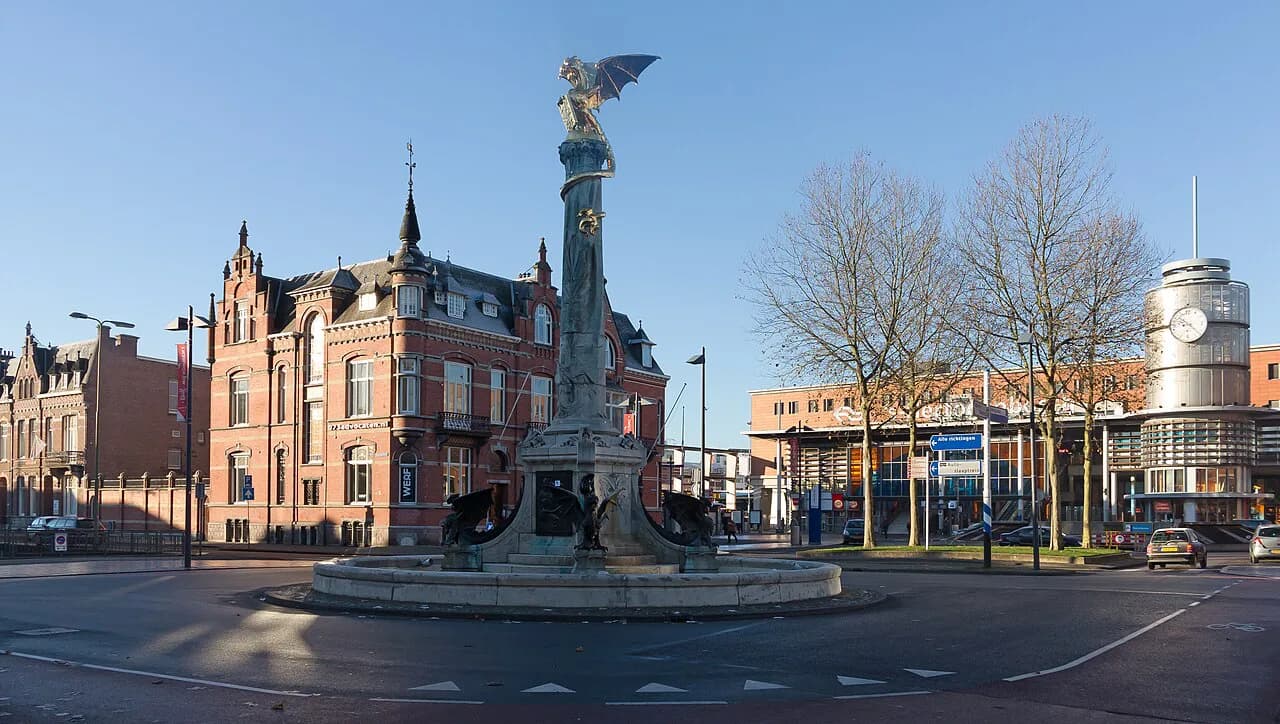
Drakenfontein in Den Bosch: the Dragon Fountain at Stationsplein

The Drakenfontein is a short stop, not a half-day out: an open-air monument on Stationsplein, directly opposite Den Bosch's central station, and worth ten minutes on the walk between the platform and the old centre. It is one of the city's best-known dragon references, tied to the old nickname Moerasdraak, and seeing it costs nothing because it stands in the open on a public square. This guide covers what the fountain is, why a dragon stands by the station and what sits within easy walking distance.
What the fountain is and where it stands
The fountain stands on Stationsplein, the square in front of the central station, on the walk into the historic centre. It is treated as public art and heritage rather than a ticketed attraction, so you view it from street level as an open-air monument. It is also known as the Bossche Draak, the dragon of Den Bosch, a name used on the city's visitor listings.
Treat the visit as a landmark, not a museum: there are no rooms to tour and no exhibition to read. What you get is a piece of city identity placed where arriving travellers meet Den Bosch for the first time. That position is the point, and it explains why the monument works as the opening frame for a city break.
How to reach it from the station and the centre
Arrive by train and you are already there: the square sits on the station side, so the fountain is the first thing to look at before crossing towards the centre. Coming from the Markt and the historic streets, walk in the direction of the station and the square opens up in front of you. It makes an easy first or last stop rather than a detour.
Because it stands outside on a public square, you simply see it when you pass; there is no interior to enter. The full set of city sights sits elsewhere, and our guide to Den Bosch Attractions: 12 Visitor Guides maps the rest of the cluster if you want to build a route around it.
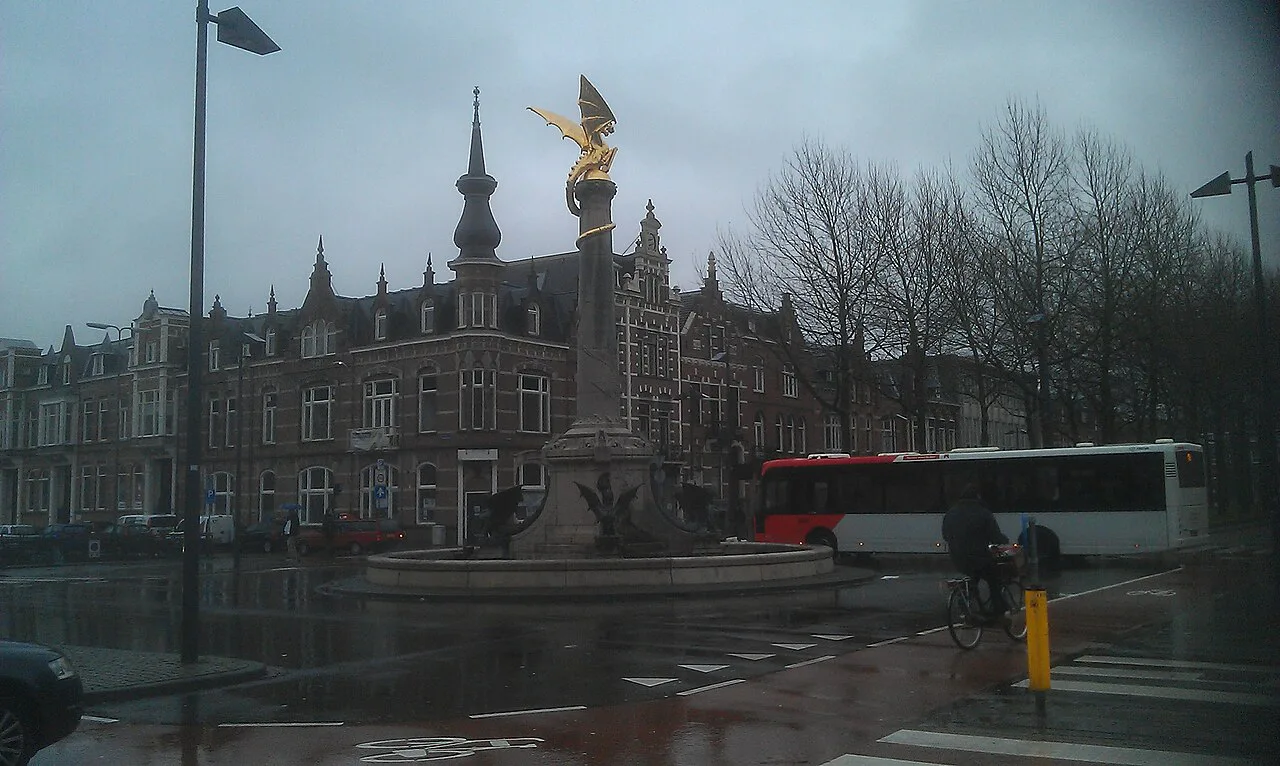

Why Den Bosch is called the Moerasdraak
Den Bosch grew up between marshes, rivers and wet ground, and that soggy setting was its main defence for centuries. Combined with heavy fortifications, the water made the town extremely hard to reach for an attacking army, and the nickname Moerasdraak, swamp dragon, grew out of that reputation. Museum Kruithuis tells the story of the fortress city and its gunpowder in its own exhibitions, which is where the nickname makes most sense.
The dragon in that story stands for stubborn resistance and strategic strength rather than fantasy; the monument outside the station carries a military meaning into the modern street. The nickname stuck until the defences finally broke: in 1629 stadtholder Frederik Hendrik drained the surrounding marshes and took the city during the Beleg van Den Bosch, the siege that ended its run as near-unconquerable.
The fountain's origin: revealed in 1903
The fountain was given to the city in 1903, and it was a gift from P.J. Bosch van Drakestein, a former King's Commissioner, made in memory of his wife and daughters. That personal dedication is why a memorial fountain, rather than a statue of a general, sits outside a railway station. De Bossche Draak records the unveiling as 19 July 1903 and describes the original function as a drinking fountain, so read it as a monument with a practical past.
Both local accounts agree on the substance: the fountain was paid for by the Bosch van Drakestein family and given to the city in 1903. Read them together and the monument stops being decorative and becomes a family memorial in a public square.
What to look for and how long to allow
Give the fountain ten to fifteen minutes and use the time to read the monument from more than one side; the dragon and the ornamental detail are the reason to stop, not the water. Look around the square and the station entrance, because the setting is part of the arrival experience. If you are travelling with children or arriving tired, this is a low-effort sight and needs no planning.
It is fully outdoors and there is nothing to shelter in, so skip it in the rain if time is short. Otherwise it works at any time of day; just treat it as a brief pause rather than a planned visit.
The dragon in the modern city
The Bossche Draak has become a local emblem, and city pride around it is real rather than a marketing line. Local makers have built an identity on the figure: a liqueur flavoured with lemon, ginger and chilli, a jewellery line, chocolate replicas and cloth badges, all sold under the dragon's name with part of the proceeds going to the fountain's upkeep. That gives you a concrete way to read the monument, as a creature locals have adopted rather than a relic they walk past.
The fountain has also been called the statue of the mothers-in-law, a joke built on the dragon's stern face and the local saying about a mother-in-law's resemblance. Keep the merchandise in perspective: it is context for the city's self-image, not an endorsement of any shop, and nothing here needs to be bought to enjoy the square.
Nearby: the fortress story and the old centre
Pair the fountain with Museum Kruithuis, where the fortress, the gunpowder and the siege give the dragon its meaning; after that the walk into the centre is short and mostly level. The Sint-Janskathedraal and the Markt sit a brief walk away, and the city's most famous painter has his own museum on the station side of town at the Jheronimus Bosch Art Center, a sensible next stop if you have half a day rather than ten minutes.
For art with more range, the Noordbrabants Museum in Den Bosch covers the province's history and visual art and sits within the same central circuit. If you are planning a full day, our list of things to do in Den Bosch puts the fountain alongside the cathedral, the canals and the Korte Putstraat area, so you can order the stops by geography.
Where to see the dragon fountain in Den Bosch
The fountain is on Stationsplein, on the station side of the centre, and it is free to look at because it stands in the open. Come at the start of a city break for orientation, or at the end while you wait for a train, and give it ten minutes rather than an afternoon. Photograph the dragon with the station behind it, then head for the Markt and the cathedral to begin the proper sightseeing.
If the dragon has done its job, the fortress story continues at the bastions and at Museum Kruithuis, and the historic centre takes over from there. Our Den Bosch Attractions: 12 Visitor Guides page collects the individual attraction guides when you want to build the rest of the day around this square.
Is the fountain worth the stop?
Yes, if you are passing through the station anyway: the Drakenfontein costs nothing, takes minutes and gives you a key to Den Bosch's dragon identity before you reach the cathedral. It is not worth a special journey on its own, and nobody should plan a morning around it. Treat it as the gateway to the old centre, then spend your real time in the museums and streets beyond.
The fountain stands in the open, so there is nothing to book; check opening days for nearby museums before you go.
Explore more Den Bosch guides
Frequently Asked Questions
Is the Drakenfontein in Den Bosch free to visit?
It stands on Stationsplein, an open public square opposite the central station, so you view it from street level as an open-air monument. There is no ticket desk because it is a monument rather than an attraction with rooms.
How long do you need at the dragon fountain?
About ten to fifteen minutes is enough to walk around it and read the monument. Most travellers see it on the way between the station and the historic centre.
Why is there a dragon at Den Bosch station?
The dragon is one of the city's best-known references to its old nickname, the Moerasdraak, earned because marshes and fortifications made Den Bosch hard to capture. The fountain was given to the city in 1903 as a gift from P.J. Bosch van Drakestein, in memory of his wife and daughters; De Bossche Draak records its unveiling as 19 July 1903.
What else is near the Drakenfontein?
Museum Kruithuis, which tells the fortress and gunpowder story behind the dragon, is the natural pairing. The Sint-Janskathedraal, the Markt and the Jheronimus Bosch Art Center are all within a short walk into town.