
Maastricht Caves: A Guide to the Grotten Noord

The Maastricht caves are man-made limestone mines cut into the St Pietersberg hill south of the city centre, and the Grotten Noord is the main section open to visitors. Guided tours leave from Luikerweg 80 and take in a maze of corridors and pillars, charcoal wall paintings, a Second World War vault, and roughly an hour and forty minutes underground.
This guide covers one place only: what the mines are, where the two public sections start, what the Grotten Noord shows you and how to fit the visit around the rest of your time in Maastricht.
The Maastricht caves are quarries, not caves
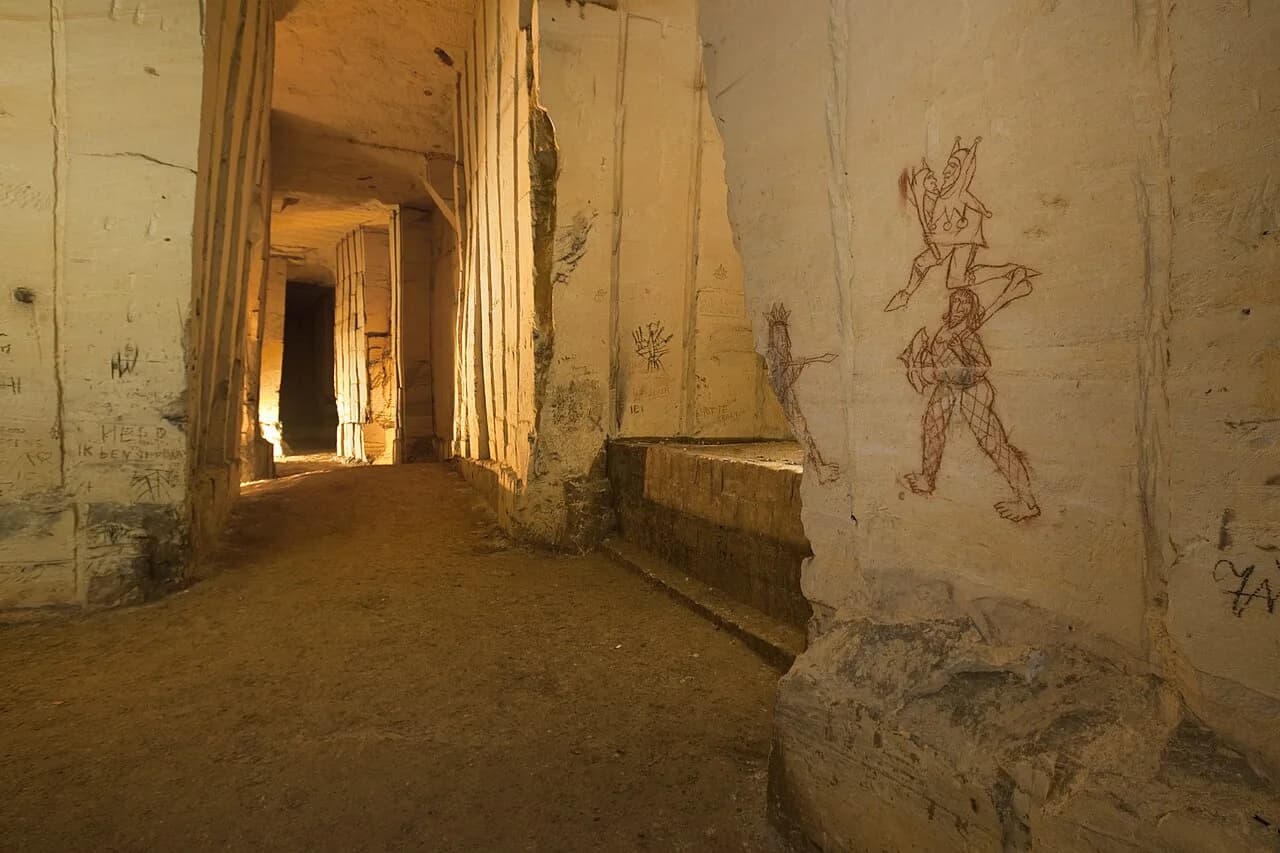
The Grotten Sint Pietersberg are former limestone quarries, worked underground rather than natural caverns, which is why the walls, floors and ceilings are all cut by hand. Miners left columns of marl in place to hold up the ceiling, a room-and-pillar method that leaves the long corridors and grids of pillars you walk through today.
Knowing this changes what you are paying for. This is industrial history and wartime history in a chilly underground grid, not a show cave with stalactites and coloured lighting, and the ceiling is low enough in places that you duck.

Where the caves are and how to get there
Both public sections sit south of the old centre inside the St Pietersberg, which rises to about 120 metres above sea level. Grotten Noord tours leave from Luikerweg 80, and Grotten Zonneberg tours leave from Buitengoed Slavante on Slavante, reached by a narrow path uphill along the ENCI plant.
From the Markt and the Vrijthof, Maastricht's two main central squares, it is a walk of well over half an hour uphill to the Luikerweg entrance, so build the journey into the half-day rather than treating the caves as a city-centre stop. The Luikerweg entrance shares its setting with Fort Sint Pieter, which makes the climb south worth it even before you go below.
Grotten Noord or Grotten Zonneberg
Two separate sections of the mine are open, and they are not interchangeable. The Grotten Noord runs tours every day through the year, usually several daily split between Dutch and English, and it is the version run as Maastricht Underground's main tour.
The Grotten Zonneberg runs Sunday afternoon tours, and during the Second World War it was the section that was actually used as an air-raid shelter prepared to hold 50,000 people. If your dates are fixed and include a Sunday, Zonneberg adds that wartime layer; on any other day, Grotten Noord is the realistic choice.
What you see on the Grotten Noord tour
The walls carry charcoal drawings and the scratched names and dates of visitors going back centuries, some of it art made with official permission and some of it graffiti from a time when leaving your mark was normal. The mine also produced fossils, including the head of a Mosasaurus found in 1770; those finds are displayed at Maastricht's natural history museum rather than in the tunnels, so the caves are not where you see the skeleton.
The standout stop is De Kluis, a small vaulted room where more than 750 Dutch masterpieces were stored during the war, Rembrandt's The Night Watch among them. Racks still line the room, though the paintings left long ago because the cold and damp are ruinous to canvas.
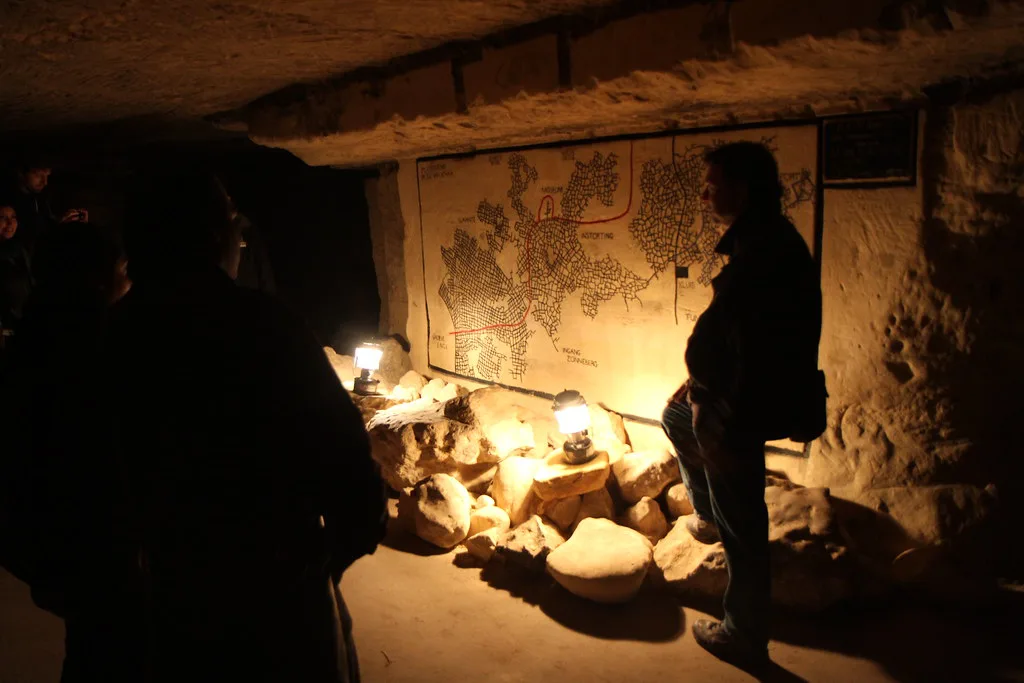
Tours run at a brisk pace, with guides covering the mining history, the smuggling of refugees and Allied pilots through tunnels that reach into Belgium, and the stories behind the drawings.
How long it takes and what it feels like underground
Expect roughly an hour and forty minutes for the tour including De Kluis, and a shorter hour on the simpler version. The temperature sits around 9-10°C year-round, so a warm layer matters even in July.
The tunnels are pitch black once the lamps go out, which is part of the experience, and the route is uneven underfoot with low passages. Wear shoes with grip; the floor is stone, not a polished walkway.
Tickets, tour times and booking
Times and languages change frequently, and booking runs online, so the ticket page for the day you want is where a departure slot gets pinned down; tours fill and the schedule shifts.
In 2023 a tour including De Kluis cost 14.80 euros, while tours without it cost 9.50 euros for ages 12 and over and 7.95 euros for children aged 4-11. Check the current rate when you book rather than relying on those figures.
Groups can arrange private tours, but they need to be booked at least ten days in advance. For a family or a small party of friends, that is a way to get a guide in your own language instead of joining a mixed group.
Above ground: Fort Sint Pieter and the Sint-Pietersberg paths
Once you surface, the hill itself is worth an hour. The paths across the Sint-Pietersberg give open trails and a good way to warm up after the chill of the mine.
Fort Sint Pieter stands on the same hill, built in 1700, and the fortress was attacked by the French in 1794. Combining the two fills a half-day without any backtracking.
Back in the centre, the obvious next stops are the Markt for the city hall and the Vrijthof for the basilicas, which you can reach on foot from the river.
Is the Maastricht caves tour worth it?
Yes, if you want a genuinely unusual tour that no other Dutch city offers, and if you can handle cold, dark and uneven ground. The combination of industrial archaeology, wartime art storage and wall art is a distinctive one.
Skip it if narrow passages and confined spaces bother you, or if your group includes very young children who will struggle with the pace and the dark. The tour is not a gentle stroll, and there is no quick exit once you are inside.
For a lighter alternative on the same hill, stay above ground with the fort and the viewpoints, then spend the afternoon at the Bonnefanten or the Onze-Lieve-Vrouweplein.
Should the caves make your shortlist?
Put the Grotten Noord on your list if you have a free half-day and want somewhere that feels unlike the rest of the Netherlands. Book the slot that fits your language, dress for 9-10°C, and plan the climb south as part of the visit rather than a detour.
Explore more Maastricht guides
Frequently Asked Questions
Are the Maastricht caves suitable for children?
The tour is a long underground walk through uneven tunnels, and it is not a gentle amble. The mined passages and the darkness can be unsettling for very young children, so weigh the pace against your group's ages if you are travelling as a family.
Are the Maastricht caves accessible?
The caves are not an accessible attraction: they are a former working mine with rough ground and no step-free route. If anyone in your group has mobility difficulties, check access with the operator before you book rather than on the day.