Dutch Golden Age Art: Where to See Rembrandt, Vermeer and Hals
Dutch Golden Age art means Rembrandt, Vermeer, Frans Hals and Jan Steen. Here is what the period was and where to see the paintings outside Amsterdam.
On this page
Dutch Golden Age art means the paintings made in the Dutch Republic during the 17th century, a period usually given as about 1620 to 1680. If you have one to four days, the efficient answer is two collections: the Mauritshuis in The Hague for Vermeer's Girl with a Pearl Earring and Carel Fabritius's The Goldfinch, and the Rijksmuseum for Rembrandt, Vermeer's The Little Street and Jan Steen. This guide explains what the period was, what the pictures look like, which names matter and how to choose between the two museums.
What Dutch Golden Age art actually is
Dutch Golden Age painting grew out of the Flemish Baroque tradition and ran from roughly 1620 to 1680. It is not a single style so much as a market: thousands of pictures made for private buyers in a small, wealthy, urban Republic, rather than altarpieces made for churches. That origin explains almost everything a visitor notices in the galleries — modest scale, everyday subjects and an unusual concentration on ordinary rooms, streets and skies.
The core genres are portraiture, landscape, still life and scenes of daily life, with group portraits of civic guards and regents a Dutch speciality. Seventeenth-century Dutch paintings by Rembrandt van Rijn, Frans Hals and Johannes Vermeer have been eagerly collected in America, which is one reason so many hang outside the Netherlands today. For a short trip that matters: the best works are not all in one country, let alone one city, so pick your museums deliberately.
Why it is called the Golden Age
The wealth behind the pictures came from trade. Dutch ships reached Asia around the Cape of Good Hope from 1595, the Dutch East India Company (V.O.C.) was founded in 1602 and the Dutch West India Company (W.I.C.) followed in 1621. Spices, porcelain and other luxury goods flowed into Dutch houses, and painters duly recorded them in still lifes.
Was Dutch Golden Age art made in Amsterdam? No — it was made across the Dutch Republic, and Delft was a major centre of production. Amsterdam's Rijksmuseum holds a superb group, but The Hague's Mauritshuis is the better single stop for Vermeer, with Girl with a Pearl Earring and View of Delft.
Why is it called the Golden Age? Because trade wealth from the V.O.C. and W.I.C., and a large urban middle class that bought pictures, produced an extraordinary volume of painting.
Who were the main painters of the Dutch Golden Age? The four to know are Rembrandt van Rijn, Johannes Vermeer, Frans Hals and Jan Steen. Carel Fabritius is the fifth name worth adding, thanks to The Goldfinch in the Mauritshuis.
That commercial society bought art on a scale hard to imagine now. Estimates vary, but between 1640 and 1659 alone, a mere twenty years, somewhere between 1.3 and 1.4 million paintings are said to have been produced in a country of roughly two million people. Perhaps only around one per cent survives, which still leaves an extraordinary number in museums and private collections.
The wealth was made against a background of war. The Dutch Republic fought its long war of independence with Spain, with a twelve-year truce from 1609 to 1621, and Peace was not signed until 1648; the Anglo-Dutch wars with England followed. The pictures rarely show any of this directly, but it is the context that paid for them.
Dutch Golden Age art can feel familiar before you arrive, because Rembrandt, Vermeer and Hals hang in museums worldwide and have shaped films and novels. Recognising a painting from reproduction is not the same as standing in front of it, which is the argument for seeing the best few in person rather than ticking off names. If you are building a wider museum circuit, our guide to the best museums in the Netherlands sets these collections alongside the rest.
What the pictures look like
The quality that struck viewers from the 17th century onwards is realism. The French critic Eugène Fromentin wrote in 1876 that we live in the picture and walk about in it, and called Dutch painting a portrait of Holland — faithful, exact, complete and lifelike. Look for it in the way light falls across a tiled floor, the sheen on a silver jug, a cloudy sky that reads as weather rather than decoration.
Everyday subjects dominate: a woman reading a letter, a courtyard, a herring on a plate, a laughing drinker. Jan Steen is the period's storyteller, and the Rijksmuseum's picture long known as A Mayor of Delft and his Daughter — properly Adolf and Catharina Croeser — is a good test of the period's range: it places its sitters outside on the Oude Delft canal with the leaning tower of the Oude Kerk behind them, so the portrait doubles as a city view. Group portraits were commissioned by militias and charity boards, which is why many of the largest canvases show a room full of named men in black.
Treat the realism as craft rather than photography. Painters composed, edited and occasionally rearranged what they saw, and a convincing surface could carry a moral point about vanity, thrift or moderation. Knowing that turns a room of still lifes from repetitive into readable, and it is worth a second look at any picture whose subject seems too ordinary to be the point.
The names to know
Four painters cover most of what a short visitor needs. Rembrandt van Rijn is the master of light, age and self-scrutiny, and produced self portraits across his whole career. Johannes Vermeer painted still, sunlit interiors and a handful of city views, and his surviving output is small. Frans Hals is the portraitist of loose, confident brushwork and lively faces, and Jan Steen the storyteller of everyday Dutch life.
Add Carel Fabritius, whose The Goldfinch of 1654 is one of the most reproduced small paintings in the world and hangs in The Hague. The bird on its perch is a good example of how a modest subject, painted precisely, can carry a room.
See it in The Hague at the Mauritshuis
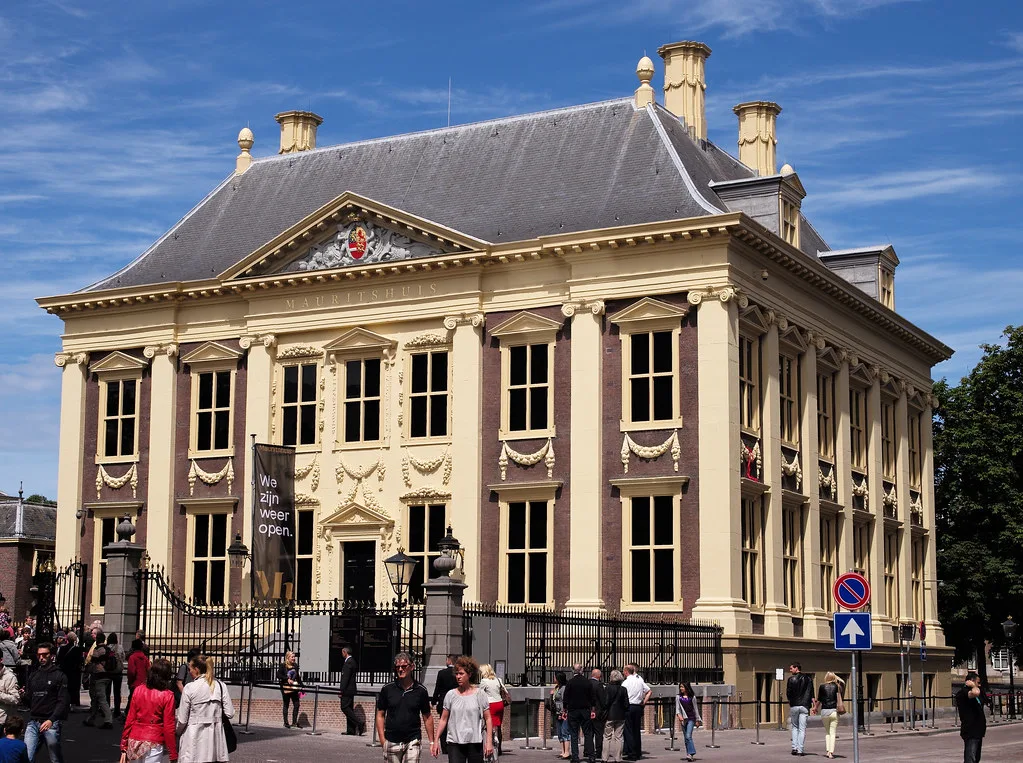
The Mauritshuis holds the strongest single concentration of these pictures for a short trip. Vermeer's Girl with a Pearl Earring is there, as are Fabritius's The Goldfinch and Vermeer's View of Delft. All three are small, which makes the museum manageable in a half day and means you can look properly rather than queue past.
View of Delft rewards a closer look because Vermeer took artistic liberties with the city's topography. The view is recognisable but not a surveyed record, so compare it with the real Delft only in the broad shapes: the church towers and the light on the water. That tension between exactness and arrangement is the most interesting thing in the painting.
Pair the Mauritshuis with the rest of The Hague if you have the time. The Binnenhof, the city's political centre, sits a short walk away, and the Mauritshuis is close to the centre rather than out in a suburb, so the museum slots easily into a walking day. Opening days and ticket arrangements change, so confirm current details before you travel.
See it at the Rijksmuseum
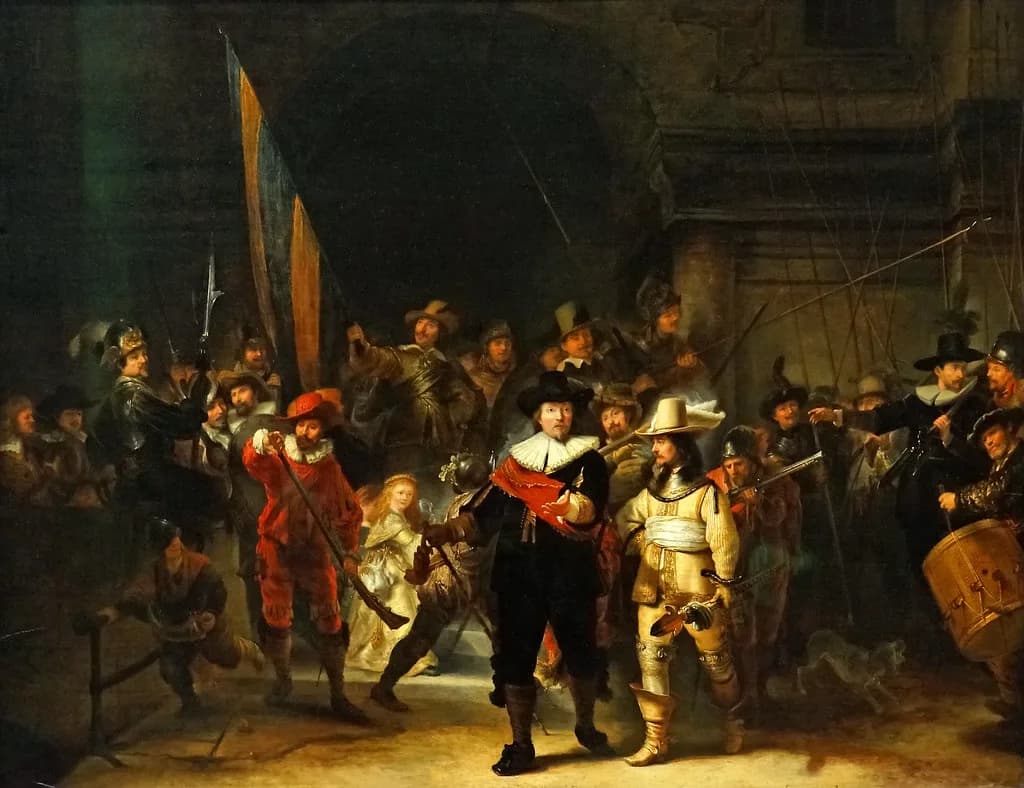
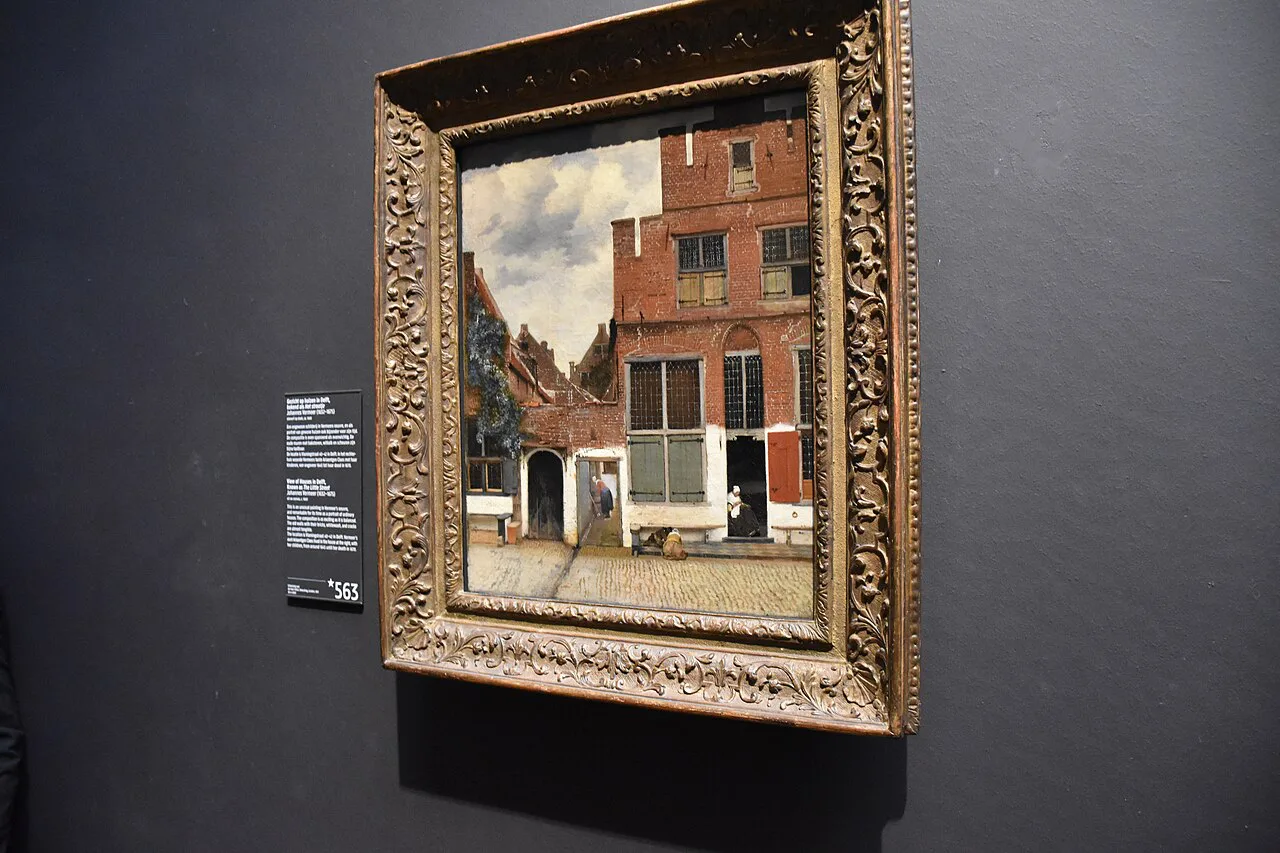
The Rijksmuseum in Amsterdam holds the other essential group, including Rembrandt's Night Watch, Vermeer's The Little Street and Jan Steen's Adolf and Catharina Croeser, long known as A Mayor of Delft and his Daughter. The Steen is a good test of the period's range: it places its sitters outside on the Oude Delft canal with the leaning tower of the Oude Kerk behind them, so the portrait doubles as a city view.
Vermeer's The Little Street is a reminder that the view may no longer be checkable: the house as painted does not survive in that state. The Rijksmuseum is a large museum with a lot beyond the Golden Age, so decide before you go whether you are there for the Dutch paintings or for everything. Budget more time for the former than you think.
The Rijksmuseum sits in Amsterdam, but remember that Dutch Golden Age painting belongs to the Dutch Republic as a whole, not to the capital. Delft was a real centre of production, and The Hague's collection is the better single stop for Vermeer. If you have four days, a Hague day plus Amsterdam works well; if you have one, choose one museum and see it properly.
How to read one painting
Start with the light and ask where it comes from, then find what the painter wanted you to notice: a reflection, a letter, a glance towards you. In a group portrait, look at who is looking out and who is turned away; Dutch civic groups were carefully arranged. In a still life, check what has been peeled, spilled or half-eaten, because that is often where the moral sits.
Then step back and consider the size. A painting made for a merchant's front room is small and intimate, while a militia portrait was made for a hall. That single fact tells you more about the Dutch market than any label, and it is why the Mauritshuis's small panels and the Rijksmuseum's large canvases feel like two different worlds.
Choosing between The Hague and a wider circuit
With one to four days, one strong collection beats spreading thin across several cities. The Mauritshuis gives you Girl with a Pearl Earring, The Goldfinch and View of Delft in a compact building, which suits a half day in The Hague. The Rijksmuseum gives you breadth and the Night Watch, at the cost of a bigger, busier visit and more time on your feet.
If you have two days, do both and travel between them rather than adding a third city. The trade-off is that Amsterdam is not the Netherlands; if you want Delft's canals or The Hague's Binnenhof, build the plan around those places and treat the Rijksmuseum as the Amsterdam anchor. Ticket prices, opening hours and any timed-slot requirement are published by each museum, so check the official site for your dates rather than relying on old figures.
What the pictures leave out
The Golden Age was also a period of colonial expansion and near-continuous war, and the paintings mostly filter that out. The V.O.C.'s monopoly on trade with Japan, held from 1640 to 1854, and the luxury goods that filled Dutch houses appear in still lifes as beautiful objects, not as the ships, ports and people that produced them. Striking as the realism is, the pictures are a portrait of Holland with much of what paid for it left outside the frame.
Keep that in mind in the galleries without letting it spoil the pleasure of the pictures. The men who commissioned these portraits were often the same men directing the companies and the war, and a few labels will tell you so. For a visitor, the useful skill is reading the wealth in the objects and then asking who paid for them. If your short break is in The Hague, the Binnenhof a short walk from the Mauritshuis makes that connection concrete.
Which collection should you book first?
Book the Mauritshuis first if you want Vermeer and Fabritius in a manageable half day; it is the sharper hit for a one- or two-day trip. Choose the Rijksmuseum first if you want breadth, Rembrandt and a full day indoors, and accept that you will see the Dutch Golden Age as one strand of a much larger collection. For how the Dutch museum card works, see the Museumkaart guide, and for the wider picture read the best museums in the Netherlands.
Explore more Netherlands guides
Frequently Asked Questions
Was Dutch Golden Age art made in Amsterdam?
No — it was made across the Dutch Republic, and Delft was a major centre of production. Amsterdam's Rijksmuseum holds a superb group, but The Hague's Mauritshuis is the better single stop for Vermeer, with Girl with a Pearl Earring and View of Delft.
Why is it called the Golden Age?
Because trade wealth from the V.O.C. and W.I.C., and a large urban middle class that bought pictures, produced an extraordinary volume of painting. Between 1640 and 1659 alone, an estimated 1.3 to 1.4 million paintings are said to have been made in a country of about two million people.
Who were the main painters of the Dutch Golden Age?
The four to know are Rembrandt van Rijn, Johannes Vermeer, Frans Hals and Jan Steen. Carel Fabritius is the fifth name worth adding, thanks to The Goldfinch in the Mauritshuis.
When did the period run?
Dutch Golden Age painting is usually dated to about 1620 to 1680, growing out of the Flemish Baroque tradition. That is later than the political and commercial foundations of the Republic, which begin with the V.O.C. in 1602.
Sources
Notes for your next Dutch city break
Optional updates to our Netherlands guides.
You might also like
Continue reading
More guides you'll find useful