Cycling Rules in the Netherlands: Right of Way, Lights and Bike Paths
The Dutch cycling rules that catch visitors out: bike paths, right of way, lights, phones, hand signals and where you can and cannot leave a hired bike.
On this page
Dutch cycling rules reward a short read before you hire a bike: keep to the red cycle path, give way to traffic from the right unless white shark teeth tell you otherwise, watch the bike-specific traffic lights, and use your arm before you turn. The rules are few but they are enforced, and a visitor who ignores them pays in fines or, worse, in scraped skin. This guide works through them in the order you meet them on a ride, from the fietspad to parking and locking.
Everything here applies to an ordinary hired city bike on a one to four day break in Utrecht, The Hague, Den Bosch or Haarlem. Dutch cities are built with cyclists in mind and the cycle paths connect up, and the rules around lights, phones and parking are the ones that catch out British and American riders most often. A starter's guide is worth a read before you hire, and our guide to Cycling in the Netherlands covers more of the basics, while Bike Rental in the Netherlands explains what hire firms hand over with the bike.
Which paths you may cycle on, and why the red fietspad matters
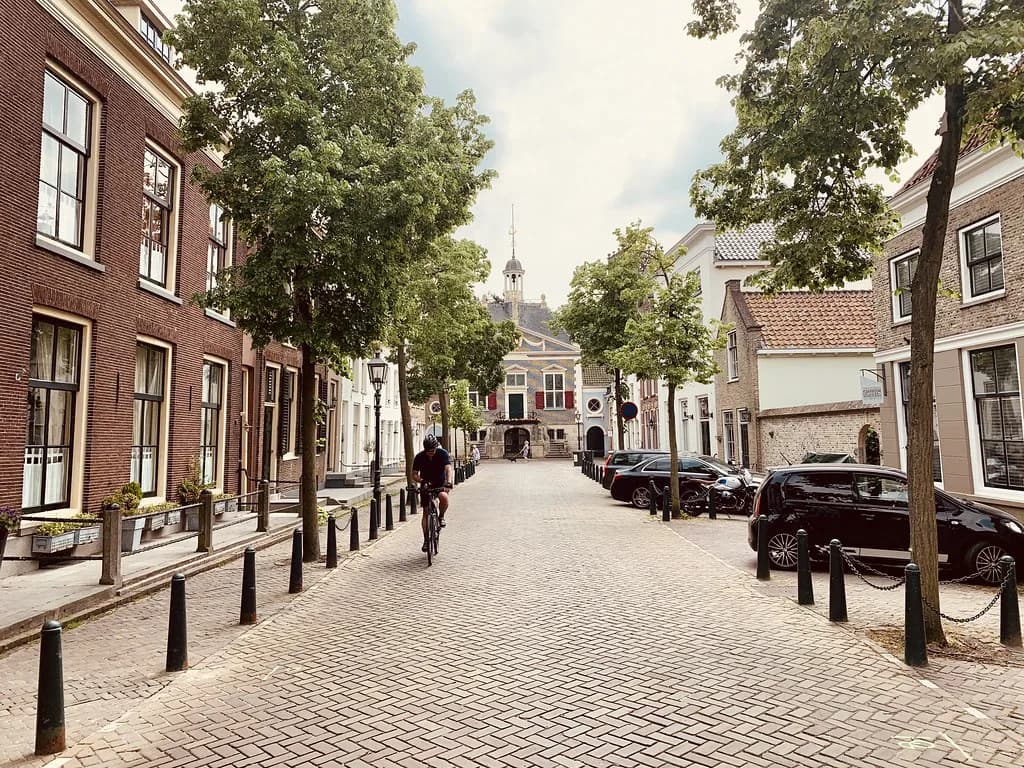
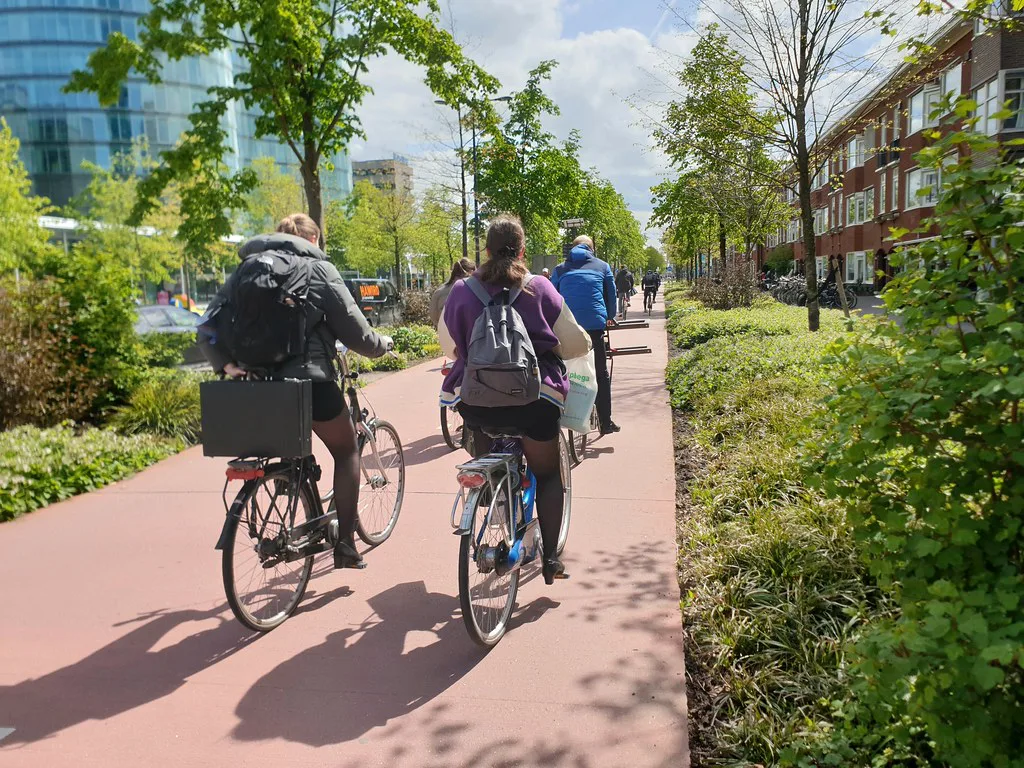
In Dutch towns the red asphalt is the fietspad, a path reserved for bikes, and you should use it wherever one runs alongside your route. Where there is no fietspad, ride on the road on the right with the traffic, never on the pavement. The red surface is your visual cue at junctions and roundabouts, and staying on it keeps you out of the tram tracks and the path of pedestrians.
Cycle paths come in several forms. A compulsory fietspad is for bikes only, a non-compulsory one is optional, and a combined path is shared with mopeds; bicycle lanes painted onto the roadway come in three versions, with a solid line, with a broken line, and suggestion lanes, and only the broken line may be crossed by a motorist. Where a path is marked as compulsory for cyclists, follow that sign.
Right of way: traffic from the right and the white shark teeth
The default rule is that the right has the right of way, so a cyclist or car emerging from a side street on your right goes first, even when that feels wrong on a wide main road. The white triangle markings known as shark teeth, or haaientanden, cancel that: they indicate that you must give way to traffic on the intersecting road. Read the road surface a few metres ahead each time you approach a junction.
Do I have to wear a helmet when cycling in the Netherlands? A helmet is not required by the rules covered here, and everyday city cyclists in the Netherlands generally go without one. The practical safety case for a helmet still stands for anyone riding an unfamiliar bike in traffic.
Can I cycle after a drink? Riding under the influence is illegal in the Netherlands and carries a fine, so plan your ride before the evening or leave the bike parked. Ask your hire company where to check the current penalty amounts.
Trams have priority, so cross the rails at a sharp angle rather than drifting along them, and never assume a bus or car will stop just because you have priority. Treat the rule as the tie-breaker, not as a force field: look, make eye contact and wait if the larger vehicle is already moving.
Bike traffic lights and turning right on red
At busy junctions, bikes have their own signals: a small set of lights showing a bicycle in red, amber and green. Obey those rather than the car lights, which may show green while the bike signal is still red. Where there is no bike signal, use the one meant for cars, and never roll through a red because the traffic around you has cleared.
One useful exception: where a sign reads rechtsaf toegestaan, cyclists may turn right even though the light is red, after giving way. It is a permission, not an obligation, so slow down and check before you use it. In every other case, a red bike light means stop.
Lights, bells and what is required after dark
Every bike must carry a bell, and after dark you need a properly attached white or yellow lamp at the front and a red light at the rear. Riding without a bell or without lights at night is an offence and carries a fine. Hire bikes usually come with both fitted, so check the lights work before you ride away from the shop.
Use the bell as a polite signal, not a rebuke: a short ring tells a pedestrian on the path that you are passing, and it is far better received than a shout. Be aware that the bike-lighting requirement is about being seen, so a dim lamp pointed at the tarmac defeats the point. Ask at the hire desk how the lights switch on if the fitting is unfamiliar.
Phones, alcohol and other things that earn a fine
Using a mobile phone while cycling is illegal in the Netherlands, for texting, browsing or holding a call. Hands-free calling and listening to music are allowed, provided you can still hear traffic. Pull over and stop, or wait until you are off the bike, to use the phone: using it is illegal while riding, so treat any moment in the saddle as hands-off the screen.
Riding under the influence is also illegal and carries a fine. It is a good habit to treat a Dutch bike ride like a short car journey, giving the road your full attention.
Hand signals when turning left or right
Bicycles have no indicator lights, so you signal with your arm: straight out to the left for a left turn, straight out to the right for a right turn. Signal in good time, before you slow down, so the rider behind you can adjust.
Locals often skip the signal, but do not copy them; as a visitor on an unfamiliar bike, your arm is the clearest thing you have. Do a shoulder check before you move out, and keep both hands ready on the brakes in busy streets. If you are riding in a group, agree turns and stopping points before you set off.
Where you can park a bike, and what happens if you park badly
Park only in designated bike racks or stalls, and obey signs reading Hier geen fietsen plaatsen, which means no bicycles here. Ignoring one can mean the bike is confiscated by the police, and for a visitor that is a lost deposit and a ruined day. Dutch towns have bike stalls near the centre, so walk a few extra minutes rather than leaning your bike against a shop window.
Wrong parking carries a fine and the removal of the bike, plus the hassle of dealing with the gemeente, the local authority. That is more than most people want to spend on a coffee stop. Note where you left the bike, and photograph the rack if you are in a large square with several parking areas.
Locking a hired bike properly
Always lock a hired bike, and lock it to something fixed: a rack, a lamp post or railings. A U-lock or a sturdy chain lock passed through both the frame and the front wheel is the standard method, and it is why rental firms hand over a heavy lock with the key. Keep the key with you and remember where you parked.
Bike theft is a real risk in Dutch cities; a visitor guide puts it at three thousand bikes stolen in the Netherlands every day. If you leave the key in the lock, rental insurance may not cover the loss, so the small habit of pocketing the key every time pays off. Report a theft to the police and to the hire company straight away.
Riding two abreast and sharing narrow paths with pedestrians
You may ride two abreast where there is sufficient space and you are not impeding other road-users, but single out on narrow paths, bridges and anywhere a pedestrian is walking. A Dutch cycle path often curls past a pavement where people step out without looking, so ring the bell early and ease off the pedals. Ride at a speed that lets you stop within the space you can see.
On a longer day out, signposted numbered junctions make navigation simple, and the same rules of the path apply throughout. If you are plotting a route beyond the city, our guides to the knooppunten network and to cycle routes in the Netherlands set out how it links towns.
What to learn before your first Dutch ride
Cycle rules in the Netherlands fit on a postcard: red fietspad, right before left unless shark teeth say otherwise, bike lights before car lights, signal with your arm, no phone, no drink, and lock the bike to something solid. Learn those and you can ride any Dutch city with confidence on a short break.
The rule that catches most visitors is not the exotic one but the ordinary one: giving way to the rider on the right at an unmarked junction. Practise that at the first quiet crossroads and the rest of the ride becomes a pleasure.
Explore more Netherlands guides
Frequently Asked Questions
Do I have to wear a helmet when cycling in the Netherlands?
A helmet is not required by the rules covered here, and everyday city cyclists in the Netherlands generally go without one. The practical safety case for a helmet still stands for anyone riding an unfamiliar bike in traffic.
Can I cycle after a drink?
Riding under the influence is illegal in the Netherlands and carries a fine, so plan your ride before the evening or leave the bike parked. Ask your hire company where to check the current penalty amounts.
Sources
Notes for your next Dutch city break
Optional updates to our Netherlands guides.
You might also like
Continue reading
More guides you'll find useful