Windmills in the Netherlands: Where to See Working Dutch Mills
Plan a Dutch windmill visit with our guide to Zaanse Schans, Kinderdijk, Haarlem's Molen de Adriaan, the Riekermolen and Sloten's working polder mill.
On this page
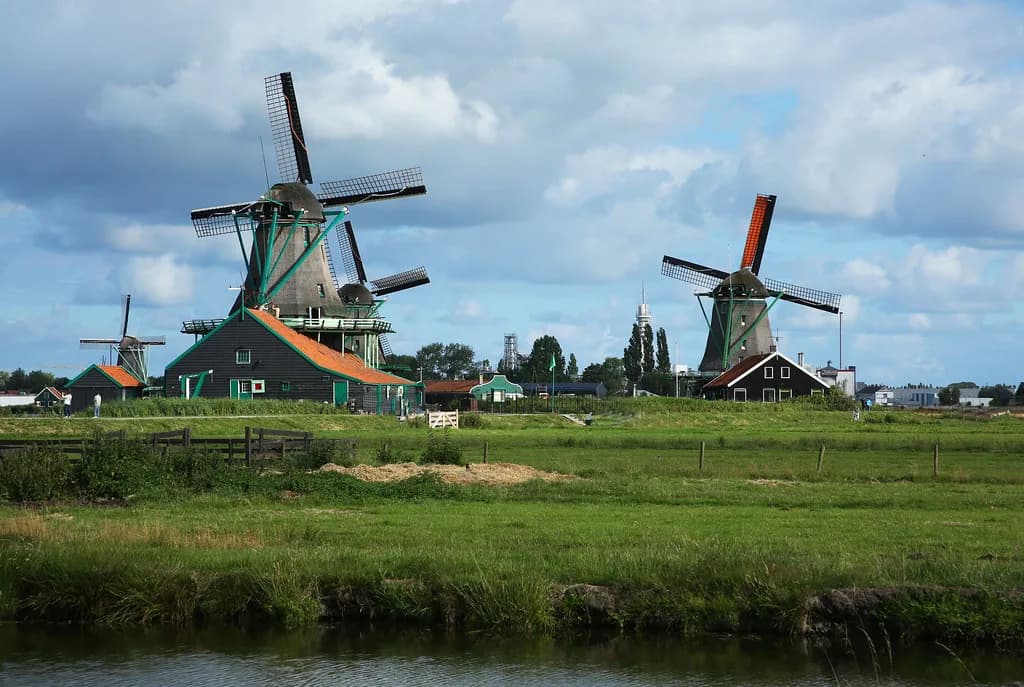
Zaanse Schans is the best single place to see Dutch windmills: a free outdoor village of historic mills north of Amsterdam, with several of them open to visitors. Kinderdijk is the alternative if you want the classic polder landscape of mills standing in water, while Haarlem, Amsterdam and Sloten each have a mill you can fold into a city break. This guide covers what the mills actually did, which ones you can enter, and how to link them by bike.
Windmills are not one thing. Some ground grain, some pressed oil or made paint, some sawed timber, and the polder mills drained land so it could be farmed or built on. Knowing which type you are looking at turns a row of sails into a story about how the country was made, and it explains why the mills cluster where they do.
What a Dutch windmill actually did
The first windmills in the Netherlands appear in the 13th century, built to grind grain into flour. Industrial uses followed: pressing oil, making paint, sawing tree trunks. Those industrial mills are why the Zaanstreek and Amsterdam became two of the country's first industrial centres.
Polder mills did different work entirely. They pumped water out of lakes and ponds, and that drainage is what created the Schermer, the Purmer and the Beemster. Without them, large parts of the Netherlands would still be water, and the landscape you cycle through today would not exist in its current shape.
At Zaanse Schans you can see the specialisation at close range. De Kat still makes pigments, paints, oils and chalk for artists, De Bonte Hen produces oil, and De Huisman grinds spices. Het Klaverblad is another of the named mills in the village. Each has its own trade rather than being a generic exhibit.
How many windmills the Netherlands has now
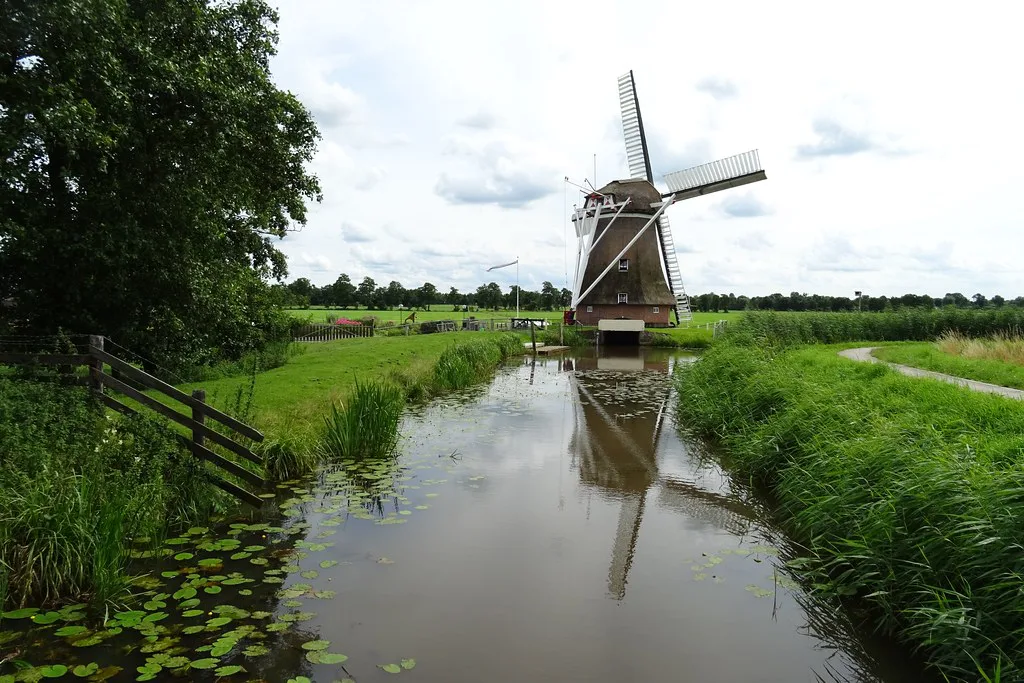
There are about 1,050 windmills and 150 watermills in the Netherlands today, a fraction of the roughly 9,000 estimated in the second half of the 19th century. Around 1731, the Zaanstreek alone had 583 windmills. Those figures are historical or approximate counts, not a live tally, and they shift as restoration work proceeds.
Which Dutch town is famous for windmills? Zaanse Schans, the open-air village of historic mills near the Zaan river, is the best-known cluster, and Kinderdijk is the other name that comes up most often for its polder-mill landscape. Haarlem's Molen de Adriaan is the town-centre mill most visitors actually walk past.
How many windmills are there in the Netherlands? About 1,050 windmills and 150 watermills remain, according to published figures, down from an estimated 9,000 in the second half of the 19th century. Treat the number as approximate, since restoration and loss change it over time.
Where are all the windmills in the Netherlands? They are spread across the country rather than gathered in one place. The Zaanstreek and Amsterdam became early industrial centres because of their mills, polder mills drained the Schermer, Purmer and Beemster, and individual mills survive in towns such as Haarlem and in Amsterdam's Sloten district.
The decline came in stages. After the Second World War, economic and technical change brought most of the remaining mills to a standstill, and steam power had already made millers less dependent on waiting for wind. Protection status and volunteer millers are what keep the survivors turning.
Zaanse Schans: the open-air village of mills
Zaanse Schans is a free outdoor park with a collection of historic windmills, open year-round. That distinction matters: the park itself costs nothing and can be wandered any day, while most of the individual windmills open to visitors from April to October. Treat the seasonal mill access as what the village publishes rather than a guarantee for your dates.
Beyond the mills, the village has clog-making demonstrations, a cheese farm and souvenir shops. The wooden houses and barns of the Zaan region give it the look of a mid-19th-century settlement, and it is best explored on foot. Arriving from the station means a walk of about fifteen minutes through the village street.
The trade-off is straightforward. You can see the mills and the village for nothing, but going inside a working mill is the part that explains the machinery. Budget for paid entry to one or two mills rather than trying to enter them all, and check the village's own listing for which are open on your day.
Kinderdijk: the polder-mill landscape
Kinderdijk is the other name that comes up whenever Dutch windmills are discussed, and it is the one for the drained-polder picture: mills lined up along water rather than a village street. If your mental image of the Netherlands is mills reflected in a canal, this is the site that matches it.
Choosing between Zaanse Schans and Kinderdijk comes down to what you want from the day. Zaanse Schans gives you craft workshops, a village and mills you can enter; Kinderdijk gives you the landscape and the engineering story of water management at scale. With one day and no bike, pick the one that matches your interest rather than trying to do both.
Molen de Adriaan in Haarlem
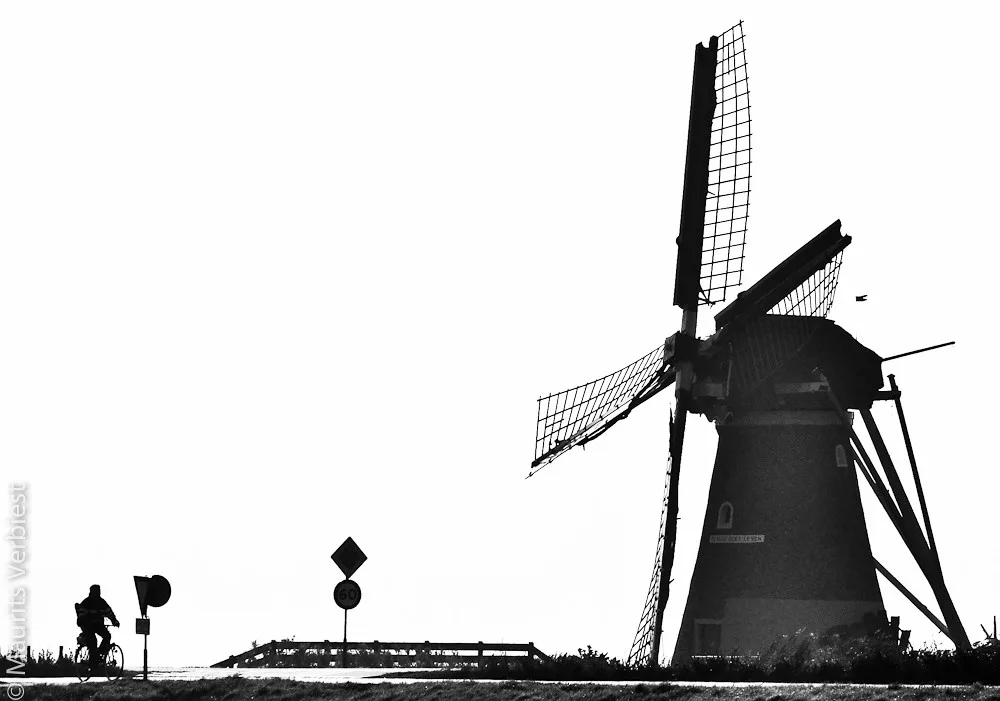
Molen de Adriaan stands on the river Spaarne in the heart of Haarlem, on the foundations of a tower that once defended the city centre. The original mill was built in 1778, burned down in 1932, and was rebuilt after seventy years of local fundraising. The platform above the river gives you a view back over old Haarlem.
For a city break, this is the most efficient mill on the list: it sits inside a walkable centre with museums and canals around it, so it costs you an hour rather than a day. Pair it with the rest of Haarlem and treat the mill as the landmark that orients you along the Spaarne, or use the city as a base for the best museums in the Netherlands outside Amsterdam.
De Gooyer in Amsterdam Oost
De Gooyer is the biggest windmill in the country, an octagonal mill dating from 1725 that once worked as a flour mill. It is a fixture of the Amsterdam Oost skyline and sits next to Brouwerij 't IJ, whose terrace has made the mill a recognisable symbol.
This is a mill to look at rather than tour as a heritage visit. It earns its place on a city break because you can see it while exploring the eastern neighbourhoods, and the brewery next door is a landmark for finding it rather than a reason in itself.
De Riekermolen on the Amstel
A short cycle south of Amstelpark along the Amsteldijk brings you to De Riekermolen, built in 1636 to drain the surrounding land. A bronze statue of Rembrandt stands nearby, marking the spots where he sketched the area. The mill no longer works the polder but still stands as a marker of how the land was managed.
Further downriver is Rembrandthoeve, a traditional farm dating from the 15th century that makes clogs and Gouda cheese, with free tours and tastings available daily. Combining the two makes a half-day ride out of the city rather than a single stop.
Molen van Sloten: the working polder mill in Amsterdam
Molen van Sloten is a reconstructed working polder mill from 1847 and the only mill open to the public in Amsterdam. Inside, an audiovisual presentation called Rembrandt in the Attic covers Rembrandt's life, and a model labelled Amsterdam and the Water shows the landscape in 1630 before the land was drained.
The setting adds to it. Brouwerij de 7 Deugden and the ice-cream parlour IJshoeve Sloten sit next door, and the old village of Sloten is worth a wander. The mill shop sells booklets for a walking tour of the neighbourhood, which makes this the mill to choose if you want interpretation rather than just a photograph.
The blue pennant: spotting an open mill
Most Dutch mills are run by volunteers, and many welcome visitors on Saturdays. The signal is a blue pennant: if it is flying, everyone is welcome. That convention is the single most useful thing to know if you are cycling past mills that are not part of a formal museum site.
It is not a guarantee for a specific mill on a specific day. Use it as a live signal on the ground, and rely on the site's own published information for anything you are travelling a long way to see.
Cycling between the mills
Three routes cover most of what a short trip needs. An Industrial Heritage route follows the windmills and shipyards along the River Zaan, the Amstel River route links De Riekermolen and Rembrandthoeve, and a Haarlem route combines mills, art and history into a full-day ride.
The Zaan route is the strongest pick if you want density: the Zaanstreek's mill history means you pass working industrial heritage rather than isolated monuments. The Haarlem route suits a mixed day where the mill is one stop among museums and streets.
Keukenhof has a tower mill on its grounds, moved there in 1957 as a gift from the Holland-America Line. It is ornamental rather than working, and the gardens open from March to May, so it only makes sense if your trip already lines up with tulip season.
Which mill to choose
With one day and no bike, choose Zaanse Schans for mills you can enter plus clog and cheese workshops, or Haarlem for Molen de Adriaan inside a walkable city. With a bike, the Zaan route gives you the most mills per hour, and the Amstel route is the easier ride out of Amsterdam.
If you are based in Rotterdam rather than Amsterdam, Kinderdijk is the natural windmill day, and it pairs well with the city's other sights; see our guide to Kinderdijk from Rotterdam for the logistics. If you want working mills inside a city you are already visiting, Sloten in Amsterdam and De Adriaan in Haarlem are the two that need no extra journey.
Which windmill day fits your trip?
Pick Zaanse Schans if you want to go inside working mills and see crafts, Kinderdijk if the polder landscape is the point, and Haarlem or Sloten if the mill has to fit around a city break. Check the site's own listing for the day you plan to visit before you commit, especially outside the April to October window.
Explore more Netherlands guides
Frequently Asked Questions
Which Dutch town is famous for windmills?
Zaanse Schans, the open-air village of historic mills near the Zaan river, is the best-known cluster, and Kinderdijk is the other name that comes up most often for its polder-mill landscape. Haarlem's Molen de Adriaan is the town-centre mill most visitors actually walk past.
How many windmills are there in the Netherlands?
About 1,050 windmills and 150 watermills remain, according to published figures, down from an estimated 9,000 in the second half of the 19th century. Treat the number as approximate, since restoration and loss change it over time.
Where are all the windmills in the Netherlands?
They are spread across the country rather than gathered in one place. The Zaanstreek and Amsterdam became early industrial centres because of their mills, polder mills drained the Schermer, Purmer and Beemster, and individual mills survive in towns such as Haarlem and in Amsterdam's Sloten district.
Sources
Notes for your next Dutch city break
Optional updates to our Netherlands guides.
You might also like
Continue reading
More guides you'll find useful